Solar Projects Don’t Miss Timelines for the Reasons You Think
Context
The organization was executing a large portfolio of ground-mounted solar projects with clear business expectations:
Achieve ~20% project profitability through early completion
Improve working capital position by accelerating cash inflows
Enable project teams to operate independently without continuous head office intervention
While planning processes were detailed and structured, outcomes remained inconsistent and difficult to control.
What the Organization Believed Was the Problem
From management and project teams, the challenges appeared operational:
Execution plans and cash flow targets were not aligned
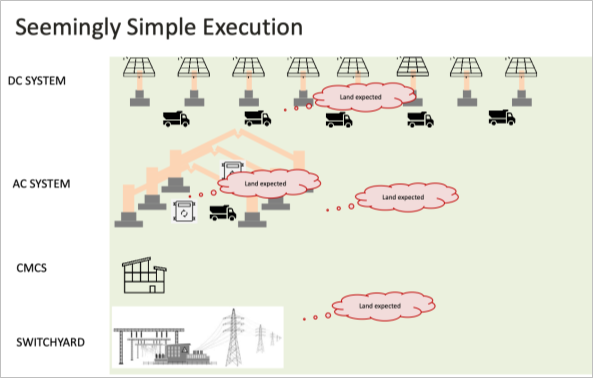
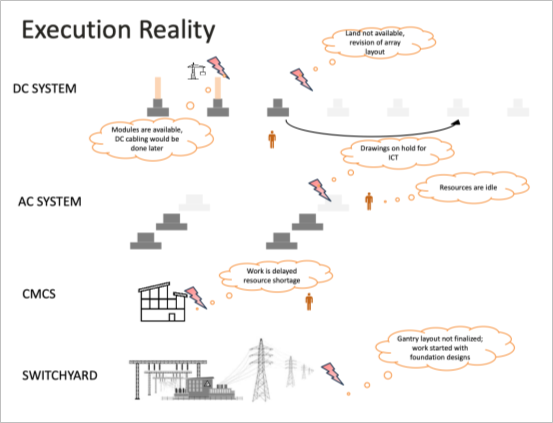
Frequent delays due to land availability, suppliers and resource shortages
Continuous need for replanning and catch-up schedules
Lack of real-time visibility across functions
Gaps between procurement decisions and site execution
Significant effort was being spent in tracking, reviews and follow-ups, but predictability was not improving.
What the Analysis Revealed
On deeper analysis, the issue was not in planning detail or monitoring intensity.
The core issue was that execution had no stable reference logic.
Execution was taking decisions on every disruption, leading to continuous plan changes
Business targets and execution priorities were not connected
Procurement decisions were optimizing cost at item level, not project completion
Multiple work fronts were opened, but closures were not structured
Handovers between stages were not clearly defined
As a result:
Baseline plans kept losing relevance
Cash flow projections were constantly revised
Projects showed activity, but completion did not move proportionately
Execution was reactive, not structured.
Shift in Execution Approach and Implementation
The change was to establish a stable execution structure that does not shift with disruptions, and to align all functions to it.
A standard execution structure was defined for solar projects, covering engineering, procurement, readiness and execution phases, with clear entry and exit conditions
Projects were broken into defined work packages with fixed handover points, so that each stage could move forward without waiting for partial completion
A single execution plan was created and used across all functions, replacing multiple disconnected schedules
Execution sequencing was aligned to cash flow triggers and commissioning milestones, so that project decisions directly supported business outcomes
Procurement decisions were aligned to this plan, ensuring material availability matched actual execution readiness instead of cost-driven ordering cycles
Reviews were redesigned to focus on where execution was deviating from the plan and what actions were required to restore flow, instead of creating new catch-up plans
Streamliner was used to run the plan on a daily basis, track readiness and progress, and ensure all stakeholders were working to the same priorities
Financial milestones were mapped to execution progress to improve visibility of cash flow impact
Outcome
Stable execution plans that did not change with every disruption
Significant reduction in replanning effort
Better alignment between procurement and site execution
Reduction in rework and split orders
Faster readiness of key areas leading to earlier commissioning triggers
Improved linkage between execution progress and cash flow
Projects started moving based on completion of work, not volume of activity.
Key Takeaway for Leadership
In solar EPC projects, delays are often attributed to external uncertainties. However, the more fundamental issue is absence of a stable execution structure. When execution is aligned to clear phases, readiness and business outcomes, projects become predictable and financially efficient.
Solar Projects Don’t Miss Timelines for the Reasons You Think
Mohd Aadil Siddiqui
Context
The organization was executing a large portfolio of ground-mounted solar projects with clear business expectations:
Achieve ~20% project profitability through early completion
Improve working capital position by accelerating cash inflows
Enable project teams to operate independently without continuous head office intervention
While planning processes were detailed and structured, outcomes remained inconsistent and difficult to control.
What the Organization Believed Was the Problem
From management and project teams, the challenges appeared operational:
Execution plans and cash flow targets were not aligned
Frequent delays due to land availability, suppliers and resource shortages
Continuous need for replanning and catch-up schedules
Lack of real-time visibility across functions
Gaps between procurement decisions and site execution
Significant effort was being spent in tracking, reviews and follow-ups, but predictability was not improving.
What the Analysis Revealed
On deeper analysis, the issue was not in planning detail or monitoring intensity.
The core issue was that execution had no stable reference logic.
Execution was taking decisions on every disruption, leading to continuous plan changes
Business targets and execution priorities were not connected
Procurement decisions were optimizing cost at item level, not project completion
Multiple work fronts were opened, but closures were not structured
Handovers between stages were not clearly defined
As a result:
Baseline plans kept losing relevance
Cash flow projections were constantly revised
Projects showed activity, but completion did not move proportionately
Execution was reactive, not structured.
Shift in Execution Approach and Implementation
The change was to establish a stable execution structure that does not shift with disruptions, and to align all functions to it.
A standard execution structure was defined for solar projects, covering engineering, procurement, readiness and execution phases, with clear entry and exit conditions
Projects were broken into defined work packages with fixed handover points, so that each stage could move forward without waiting for partial completion
A single execution plan was created and used across all functions, replacing multiple disconnected schedules
Execution sequencing was aligned to cash flow triggers and commissioning milestones, so that project decisions directly supported business outcomes
Procurement decisions were aligned to this plan, ensuring material availability matched actual execution readiness instead of cost-driven ordering cycles
Reviews were redesigned to focus on where execution was deviating from the plan and what actions were required to restore flow, instead of creating new catch-up plans
Streamliner was used to run the plan on a daily basis, track readiness and progress, and ensure all stakeholders were working to the same priorities
Financial milestones were mapped to execution progress to improve visibility of cash flow impact
Outcome
Stable execution plans that did not change with every disruption
Significant reduction in replanning effort
Better alignment between procurement and site execution
Reduction in rework and split orders
Faster readiness of key areas leading to earlier commissioning triggers
Improved linkage between execution progress and cash flow
Projects started moving based on completion of work, not volume of activity.
Key Takeaway for Leadership
In solar EPC projects, delays are often attributed to external uncertainties. However, the more fundamental issue is absence of a stable execution structure. When execution is aligned to clear phases, readiness and business outcomes, projects become predictable and financially efficient.
Lorem ipsum dolor sit amet, consectetur adipiscing elit. Suspendisse varius enim in eros elementum tristique. Duis cursus, mi quis viverra ornare, eros dolor interdum nulla, ut commodo diam libero vitae erat. Aenean faucibus nibh et justo cursus id rutrum lorem imperdiet. Nunc ut sem vitae risus tristique posuere.
Lorem ipsum dolor sit amet, consectetur adipiscing elit. Suspendisse varius enim in eros elementum tristique. Duis cursus, mi quis viverra ornare, eros dolor interdum nulla, ut commodo diam libero vitae erat. Aenean faucibus nibh et justo cursus id rutrum lorem imperdiet. Nunc ut sem vitae risus tristique posuere.
Lorem ipsum dolor sit amet, consectetur adipiscing elit. Suspendisse varius enim in eros elementum tristique. Duis cursus, mi quis viverra ornare, eros dolor interdum nulla, ut commodo diam libero vitae erat. Aenean faucibus nibh et justo cursus id rutrum lorem imperdiet. Nunc ut sem vitae risus tristique posuere.
Heading
This is some text inside of a div block.
Share
Contact us to find out more
Our Customer Service Teams have hundreds of Industry specific studies to draw from ... get in touch if you want to see something specific to your needs, or simply explore how we can deliver Radical Results for you.

.png)