

.png)
Shyam Metalics – Long-Shut Steel Complex Restarted & Commissioned in 16 Months
Case Summary
- 01
Challenges
- Long-closed steel complex with incomplete engineering and missing drawings
- Procurement delays with 40–70 POs delayed by 45+ days
- L1-based supplier selection without capacity validation
- Fragmented material delivery causing start–stop execution
- Partial civil handovers leading to rework and congestion
- Manpower mobilization at only 60–70% of required strength
- Mid-phase scope changes adding ~60 days delay
- 02
Our Work
- Restructured ordering into system-wise construction batches
- Closed budget gaps and fast-tracked long-lead approvals
- Introduced strict Full-Kit readiness before releasing work fronts
- Reorganized manpower to focus on high-impact zones
- Sequenced material dispatch aligned to erection order
- Shifted tracking from activity-based to velocity-based control
- 03
Results
- Mechanical completion achieved within 11 months
- Execution velocity improved to near-required levels
- Procurement throughput improved from ~50% to ~70%
- Vendor delivery adherence exceeded 90% in final quarter
- Major work zones achieved 90%+ planned execution speed
Brief of the Project
In 2022, Shyam Metalics & Energy Ltd acquired Ramsarup Industries, a steel facility that had remained closed since 2008. At the time of acquisition, several capital projects at the site were partially executed and left incomplete for years. Engineering documentation was fragmented, drawings were missing or outdated, and multiple systems had been installed only partially.
Two major units formed the core of the expansion scope: a Mini Blast Furnace and a Sinter Plant, both at approximately 50–60% completion. The objective was to complete and commission both units within 12 months, targeting September 2025, while simultaneously reconciling legacy drawings, installed equipment, and incomplete engineering data.
This was not a greenfield execution. It was a restart of a long-abandoned facility with significant technical, commercial, and executional complexity.
Why Timely Delivery Was Critical
For Shyam Metalics, delay had direct and measurable financial impact:
- Blast Furnace: each month of delay meant ₹13.5 Crore bottom-line loss
- Sinter Plant: each month of delay meant ₹15 Crore loss, comprising:
- ₹7.7 Crore additional coke consumption
- ₹7.5 Crore loss in productivity due to non-availability of sinter feed
- Combined exposure: over ₹25 Crore per month
This made on-time delivery a business imperative.
Situation When Realization Was Engaged and What We Found
When Shyam Metalics & Energy Ltd engaged Realization Technologies, both the Mini Blast Furnace and the Sinter Plant were already under execution. Site activity was visible across civil, structural, and mechanical fronts, and multiple contractors were mobilized. Despite this, completion and commissioning dates were slipping without a stable recovery path.
A detailed review was carried out jointly with the SMEL team to understand why sustained effort on site was not translating into predictable closures.
1. Procurement Status and Loss of Flow
The review showed that procurement was the single largest contributor to loss of execution flow.
By March 2025, ordering progress stood at about 60% for the Blast Furnace and 56% for the Sinter Plant, leaving a significant portion of long-lead items still unplaced. Budget freezes and prolonged auction clearances had delayed more than 40 to 70 purchase orders by over 45 days. These delays pushed fabrication starts, disrupted dispatch schedules, and extended tender approval cycles to an average of 23 days, compared to the planned 15 days.
These procurement delays had a direct downstream impact on site readiness. For example, Stock House Iron Ore handling equipment that was planned for dispatch by 15 March 2025 was shipped closer to mid-April, pushing RMHS readiness to 26 May 2025.
2. Supplier Capacity and L1-Based Awarding
Supplier selection practices further aggravated the situation. Orders were largely awarded on an L1 basis, without adequate validation of supplier capacity or existing workload.
In one critical case, a valve manufacturer already committed across multiple projects was awarded an order exceeding 1,500 valves. Manufacturing throughput was not assessed at the time of placement, resulting in 30 to 90 days delays across several valve categories. Similar patterns were observed with other suppliers, where staggered and partial deliveries left erection teams working on incomplete systems, leading to repeated manpower re-deployment, holding of unfinished lines, and rework in already installed sections.
3. Front Readiness and Parallel Execution
On the execution side, work fronts had been opened across multiple areas without ensuring full readiness. In several locations, erection began with partial civil handovers, incomplete material availability, or evolving drawings.
In the Hot Metal Bay, foundation batches were handed over in parts, causing frequent start–stop cycles during erection. Delayed procurement of structural sections such as channels and angles further disrupted continuity and forced repeated remobilization of manpower. In the Pump House, structure and piping works were taken up simultaneously, leading to congestion and rework.
Planning analysis showed limited protection against these disruptions. Out of 12 identified work sequences, 5 had less than one month of feeding buffer, leaving little room to absorb variability.
4. Execution Velocity and Manpower Availability
As a result of these conditions, average execution velocity remained below requirement, at around 73% for the Blast Furnace and 80% for the Sinter Plant.
Manpower availability added another layer of constraint. While the execution plan required an average strength of 870 personnel, peaking at 1300, actual mobilization consistently remained at 60 to 70% of target. Civil teams, in particular, were frequently operating at below 70% of planned strength.
5. Scope Volatility and Material Coordination Issues
At the same time, mid-phase scope changes, including ESP modifications, PCM civil merge, and valve design revisions, introduced additional instability and contributed nearly 60 days of delay across critical zones.
Material flow and site coordination were also fragmented. Material movement followed are active, just-in-time-by-necessity pattern rather than a structured, batch-wise delivery model. Structural steel often arrived in mismatched batches, fabricated parts reached site without matching drawings, and erection teams were forced into partial execution followed by rework. This led to repeated interruptions, idle manpower, and extended cycle times across multiple areas.
Solution Implemented – Project Execution Redesign
Based on the findings from the execution review, the focus shifted from isolated problem-solving to redesigning how the project was being executed as a system. The intent was to restore flow, stabilize work fronts, and align procurement, engineering, and site execution toward predictable closures. The redesign was implemented across five key dimension.
1. Restructuring Procurement for Flow and Accountability
Procurement was reorganized to support execution flow rather than operate as a standalone function.
Instead of fragmented, individual purchase orders, all pending procurement was restructured into system-wise, batch-level packages aligned to execution fronts. Each batch, such as RMHS conveyors, GCP, PCI, and ESP steel, was defined based on how the system would be erected and commissioned on site.
For each batch:
- delivery timelines were defined based on construction criticality
- vendor schedules were aligned to site readiness
- accountability was enforced through penalty-backed delivery commitments
This ensured that materials arrived in usable construction batches rather than as disconnected components.
2. Closing Budget Gaps and Accelerating Long-Lead Orders
Earlier, budget freezes had resulted in piecemeal approvals that delayed long-lead items and fragmented ordering.
To address this, budget finalization was carried out upfront to avoid repeated approval cycles. Critical packages such as butterfly valves, check valves, ESP steel structures, and electrical cables were prioritized through centralized approvals and daily coordination between procurement and site teams.
As a result, items such as Stock House Iron Ore handling equipment and critical waterline valves, which had been trending toward mid-April 2025 delivery, were advanced to mid-March, enabling earlier readiness of downstream systems.
3. Establishing Full-Kit Readiness Before Releasing Work Fronts
A key execution change was the introduction of a strict Full-Kit readiness discipline.
Earlier, work fronts had been opened with partial foundations, incomplete material availability, or evolving drawings. Under there designed execution approach, no area was allowed to start unless all prerequisites were confirmed available: drawings, materials, access, manpower.
This reduced start–stop cycles, minimized rework, and improved continuity of execution. By April 2025, rework in civil and structural activities had reduced sharply, and execution velocity began aligning more closely with plan.
4. Concentrating Resources for Rate Recovery
Analysis showed that manpower and equipment were spread across too many parallel fronts, diluting progress everywhere.
Resource deployment was therefore reorganized to concentrate effort on high-impact zones such as Furnace Proper, RMHS, Sinter Machine Building that governed overall progress.
Instead of opening multiple areas simultaneously, manpower was focused to drive closures in these zones. As a result, several areas within the Blast Furnace and Sinter Plant achieved significant improvement. Civil works in HBS, pipe rack, and pumphouse, and structural works in utilities, CBS, and PCI reached over 90% of planned execution speed, even though total manpower remained unchanged.
5. Aligning Material Flow with Erection Sequencing
Material mismatches had been a recurring cause of interruptions. Structural steel arrived without matching beams, fabricated parts arrived without corresponding drawings, and erection teams were forced into partial execution.
To address this, fabrication and dispatch were reorganized into small, sequenced batches aligned to erection order. This ensured that materials reached site in the sequence required for uninterrupted erection. This change was particularly effective in stabilizing execution in the Hot Metal Bay and Sinter Machine Building, where earlier material starvation had caused prolonged idle periods.
6. Making Execution Visible and Decisions Data-Driven
To sustain the redesigned execution model, monitoring and control were strengthened.
The entire execution was tracked through Streamliner, providing real-time visibility into progress status, manpower deployment & material readiness.
The review mechanism shifted from activity-based tracking to velocity-based monitoring, enabling early identification of bottlenecks and faster corrective actions. This improved accountability across teams and reduced the lag between issue identification and resolution.
Results Achieved
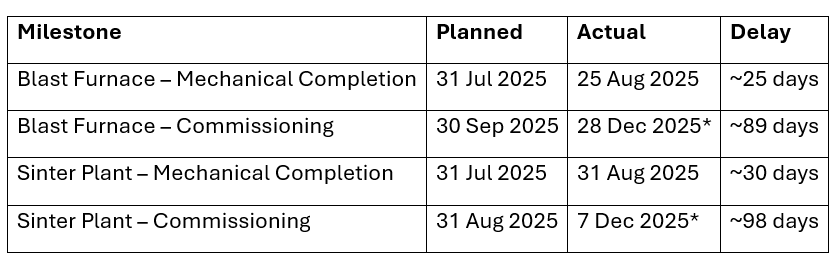
Following the execution redesign, progress across both the Blast Furnace and the Sinter Plant began to stabilize. While early-stage delays could not be entirely eliminated, the projects moved from repeated slippages to controlled closure of remaining scope.
Mechanical Completion and Commissioning Outcomes
Execution and Procurement Performance Improvements
Beyond milestone dates, several structural improvements were observed in how the project executed during the recovery phase:
- Mechanical readiness for both the Blast Furnace and the Sinter Plant was achieved within 11 months, against an aggressive 10-month target, despite legacy conditions and mid-phase scope changes.
- Average execution speed improved to near-required levels across major phases as work fronts stabilized and start–stop losses reduced.
- Procurement throughput improved from approximately 50% to 70%, driven by batch-wise ordering, centralized approvals, and tighter alignment with site needs.
- Vendor delivery predictability was restored, with over 90% adherence to committed delivery schedules in the final quarter
Read relevant articles:
Critical chain project management (CCPM): why projects remain late and how CCPM actually fixes it?
Why projects are late even when everything seems managed?
Beyond fragmentation: Toyota's cell manufacturing model offers a blueprint for construction
What if our best attempts to minimize time and cost overruns in projects are pointless?
How can we solve the late project problem
Implementing critical chain in large infrastructure projects
Part 1: Why critical chain is not a science
Part 2: Who said critical chain is not a science?
Part 3: Let's make critical chain a science


Contact us to find out more
Our Customer Service Teams have hundreds of Industry specific studies to draw from ... get in touch if you want to see something specific to your needs, or simply explore how we can deliver Radical Results for you.

Pashan Sus Road, Pashan Pune. MH- 411021 IN