
Mohd Aadil Siddiqui
July 16, 2026
.png)
Mohd Aadil Siddiqui
At its core, a project plan is meant to do a few things:
The underlying structure is simple: tasks, dependencies, timelines, and inputs. On paper, this should work.
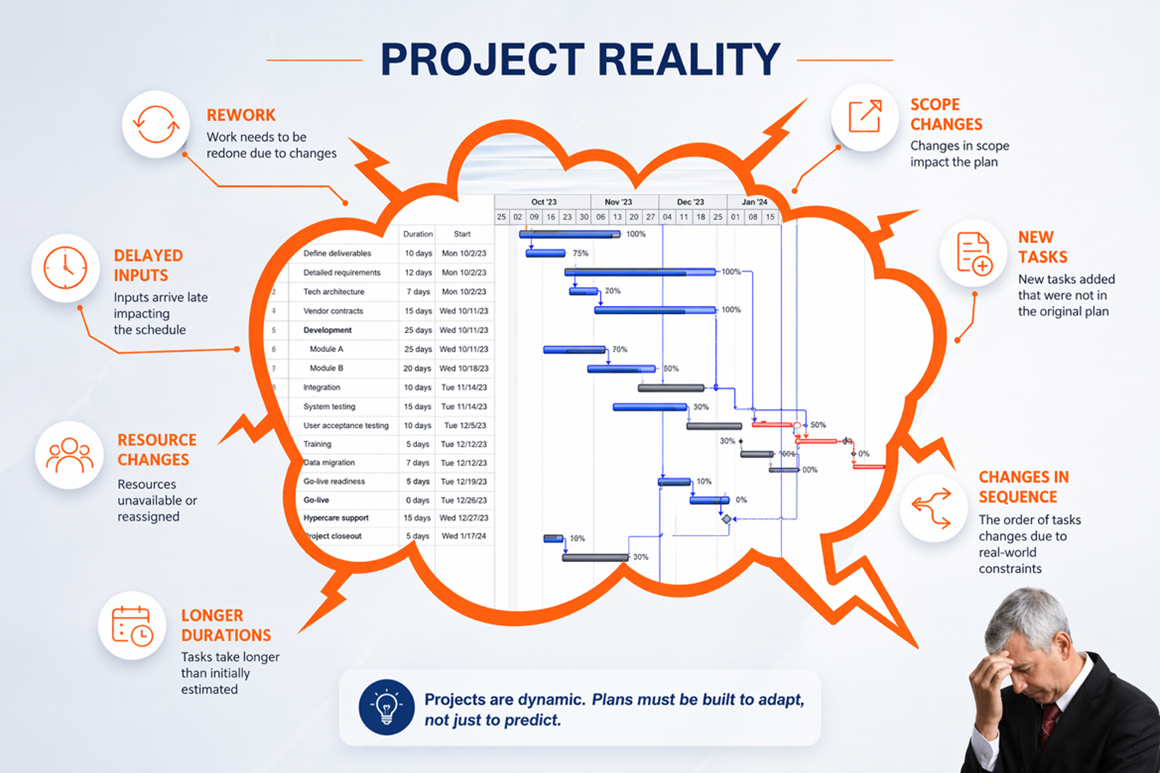
In reality, projects do not operate on fixed assumptions. Scope evolves as execution progresses, activities that looked straight forward require additional work, sequences change because the ideal order is rarely practical, resources are not available when planned, and inputs from vendors and other teams get delayed.
Individually, these are manageable. The problem is that they affect every part of the plan simultaneously.
At that point, the plan stops being a stable reference.
When the plan keeps changing, its usefulness reduces quickly. The critical path starts shifting frequently, priorities derived from the plan no longer feel reliable, and teams begin to depend more on coordination than on the plan itself.
Over time, execution moves outside the system. The plan still exists, but it is no longer what drives decisions.
The natural response is to improve planning quality, add more detail, track more frequently, update more rigorously.
But the issue is not lack of detail. It is that the plan is trying to do too much. A single structure is expected to:
In a stable environment, this could work. In a dynamic environment, it makes the plan fragile.
A more practical way to think about a project plan is as a control structure, not a detailed execution schedule.
At a high level, the plan needs to answer:
Everything else belongs closer to execution.
This is where approaches like Critical Chain become relevant, not just because of buffers, but because they change how execution is structured.
Instead of building one highly detailed plan, it is more effective to separate it into two levels:
Progress flows upward, but not mechanically. The task owner interprets execution and updates remaining work, which keeps the higher-level plan stable.
Once planning is structured this way, execution starts behaving differently.
The shift is subtle, but its impact on execution is significant.
Detailed plans fail not because they are incorrect, but because they are not designed for how projects actually behave.
Simplifying the structure, separating control from execution, and enabling larger work fronts does not reduce rigor. It is what makes execution stable in a dynamic environment.
Read more articles:
Why Software Has Struggled to Deliver in the Construction Industry?
How CCPM and Little’s Law Reduced Cycle Time in Aircraft Maintenance at WR-ALC?
Reducing Cycle Time by 33% at WR-ALC: A U.S. Air Force Case
Solar Projects Don’t Miss Timelines for the Reasons You Think
Critical chain project management (CCPM): why projects remain late and how CCPM actually fixes it?
Why projects are late even when everything seems managed?
Beyond fragmentation: Toyota's cell manufacturing model offers a blueprint for construction
What if our best attempts to minimize time and cost overruns in projects are pointless?
How we can solve the late project problem?
Implementing critical chain in large infrastructure projects
Part 1: Why critical chain is not a science?


Our Customer Service Teams have hundreds of Industry specific studies to draw from ... get in touch if you want to see something specific to your needs, or simply explore how we can deliver Radical Results for you.


