


Granules India – R&D Due-Date Performance Improved from 20% to 70%
Case Summary
- 01
Challenges
- Multiple concurrent projects, shared specialist resources and inherent scientific uncertainty across the API and Formulation Development portfolios.
- Projects frequently released into execution as soon as they were prioritised by the portfolio team, even when all start conditions or resource capacity were not yet available, increasing work in progress.
- Low due-date predictability: due-date performance was approximately 15%–25%, limiting confidence in project completion commitments.
- Premature project starts: projects or phases could begin before all required inputs, materials, decisions and downstream readiness were in place, resulting in stop-start execu
- Limited forward visibility: project plans were managed with limited dynamic visibility of interdependencies, emerging risks and projected completion dates.
- 02
Our Work
- Projects were separated into active execution, preparation and hold queues, with a new project released only when the required readiness conditions and scientist bandwidth were available. The portfolio team continued to determine business priority.
- WIP control and capacity-based release: the number of simultaneously active projects was aligned with the capacity of development scientists, the critical resource constraining portfolio flow.
- Full-Kit readiness: projects were prepared before release so that execution could continue without avoidable interruption — clear scope and target, approved development plan, required materials and reference standards, analytical and documentation readiness, facility or equipment availability, acceptance criteria, critical decisions and confirmation of relevant functional resources, depending on the project and phase.
- Planned cross-functional handovers: inputs required by the next resource group were identified in advance, reducing waiting between development activities.
- Dynamic integrated planning: API and FD project networks were integrated in Streamliner to reflect dependencies, provide execution signals and improve visibility of expected completion dates and risks.
- Cycle-time-based execution management: reviews focused on cycle-time performance, emerging constraints and corrective actions, with a cycle-time-linked measurement system agreed to reinforce the required execution behaviours.
- 03
Results
- Due-date performance improved from 15%–25% to approximately 70%, with progress continuing toward 90%.
- Scientist turnaround time reduced from approximately 18 months to 14 months, against a further target of 11–12 months.
- Project cycle time reduced from 22 months to 20 months, against a target of 18 months.
- Granules achieved its FY 2025-26 portfolio targets, with throughput tracking from approximately 8 annual deliveries toward 10
Improving R&D Portfolio Flow and Due Date Performance at Granules India
Granules India Limited is a vertically integrated pharmaceutical company with a strong presence across Active Pharmaceutical Ingredients (APIs) and Finished Dosage (FD) products in global generics markets. In June 2025, Granules partnered with Realization Technologies to strengthen execution across its API and FD R&D portfolios using Critical Chain Project Management principles. The results presented in this case study reflect approximately 15 months of implementation.
Business requirement
The engagement was initiated to improve the R&D portfolio's ability to deliver projects within committed timelines and support business-critical dates. The business aspiration was to progress from an average of approximately eight project deliveries per year toward ten deliveries per year, while improving the reliability of project due dates. Because pharmaceutical development projects have long end-to-end cycle times, the full annual throughput impact is still emerging; the current portfolio is on track toward the target rather than representing a fully realised steady-state result.
The situation before the engagement
The R&D environment involved multiple concurrent projects, shared specialist resources and inherent scientific uncertainty. Projects were frequently released into execution as soon as they were prioritised by the portfolio team, even when all start conditions or resource capacity were not yet available. This increased work in progress and made flow and completion dates difficult to manage consistently.
- Low due-date predictability: Due-date performance was approximately 15%-25%, limiting confidence in project completion commitments.
- Resource contention: Development scientists were allocated across multiple projects, leading to task switching, shifting priorities and work waiting for resource availability.
- Premature project starts: Projects or phases could begin before all required inputs, materials, decisions and downstream readiness were in place, resulting in stop-start execution.
- Limited forward visibility: Project plans were managed with limited dynamic visibility of interdependencies, emerging risks and projected completion dates.
How the execution approach changed
The portfolio team continued to determine business priority. The execution system then translated those priorities into a controlled flow of work: projects were separated into active execution, preparation and hold queues, and a new project was released only when the required readiness conditions and scientist bandwidth were available. This shifted the portfolio from starting as much work as possible to completing priority work with greater focus.
- WIP control and capacity-based release: The number of simultaneously active projects was aligned with the capacity of development scientists, the critical resource constraining portfolio flow. This reduced FD WIP by approximately 35% from 11 projects in active execution to 7 projects, and API WIP by approximately 20% from 10 to 8
- Focused scientist allocation: Development scientists were assigned more directly to active projects so that work would not wait for resource availability and scientists could complete defined work before moving to the next priority.
- Full-Kit readiness: Projects were prepared before release so that execution could continue without avoidable interruption. Depending on the project and phase, Full Kit included a clear scope and target, approved development plan, required materials and reference standards, analytical and documentation readiness, facility or equipment availability, acceptance criteria, critical decisions and confirmation of relevant functional resources.
- Planned cross-functional handovers: Inputs required by the next resource group were identified in advance, reducing waiting between development activities and improving continuity across project phases.
- Dynamic integrated planning: API and FD project networks were integrated in Streamliner to reflect dependencies, provide execution signals and improve visibility of expected completion dates and risks.
- Cycle-time-based execution management: Reviews focused on cycle-time performance, emerging constraints and corrective actions. A cycle-time-linked measurement system was agreed to reinforce the required execution behaviours.
What changed in day-to-day execution
Previously, a newly prioritised project could move directly into execution and then wait for scientist availability, materials, decisions or the next handover. Under the revised approach, priority projects are prepared to Full-Kit status and released in line with development-scientist bandwidth, enabling work to progress with fewer interruptions and clearer ownership.
Cycle-time improvement has come primarily from reducing waiting for resource assignment, readiness gaps, priority switching and handover delays rather than compressing the scientific work itself. This improves speed while protecting technical quality and required scientific iterations.
Results after approximately 15 months
The revised operating practices have stabilised portfolio execution and improved management visibility. Scientist turnaround time is measured from the point at which a scientist starts work on a project or defined development stage until the scientist is released from that assignment. This measure has reduced from approximately 18 months to 14 months, with a further target of 11-12 months.
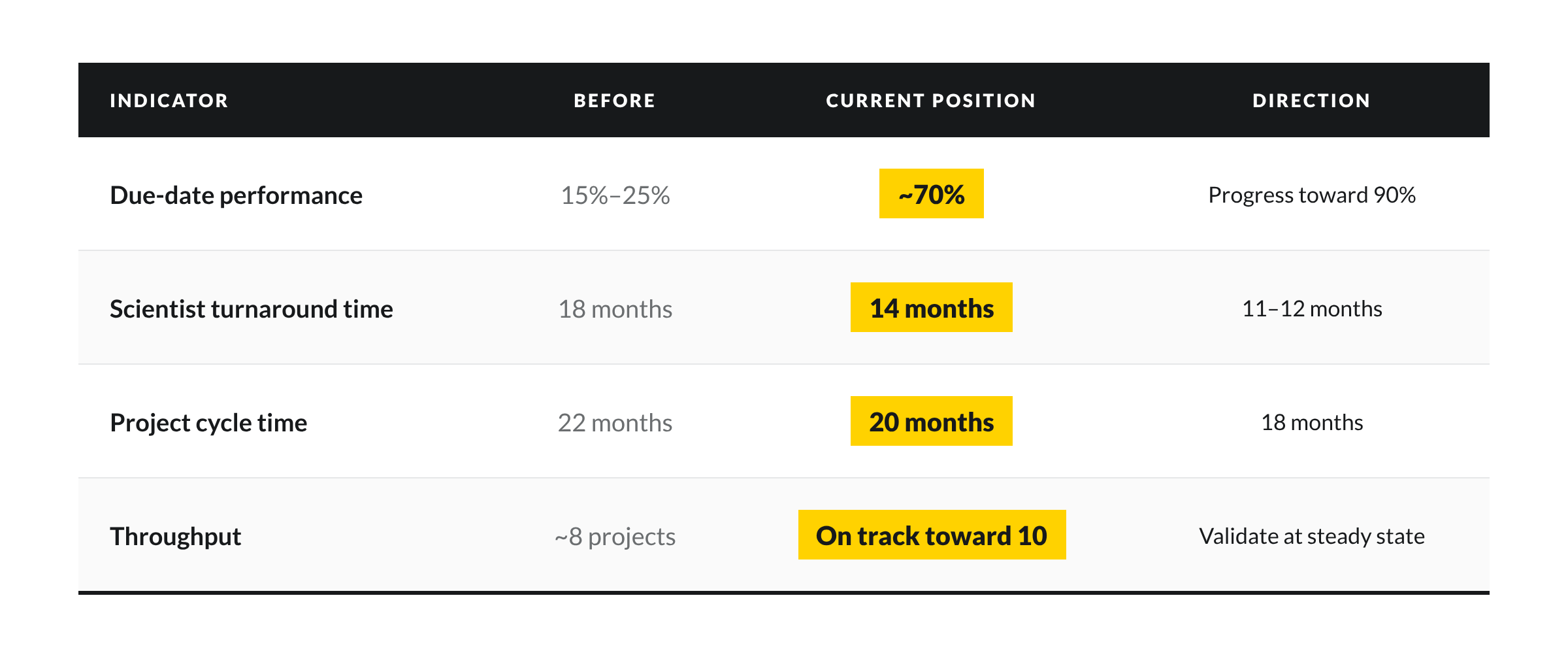
Granules also achieved its FY 2025-26 portfolio targets. The throughput improvement should be interpreted as a developing result: given the long project life cycle, the movement from approximately eight to ten annual deliveries remains a portfolio projection that will be confirmed as more projects complete under the revised execution system.
Institutionalised practices and next targets
Direct allocation of development scientists to active projects, controlled project release, Full-Kit preparation, integrated project planning and structured execution reviews are now part of the operating approach. The cycle-time-linked measurement system has also been agreed. The next phase is focused on sustaining these disciplines, achieving scientist turnaround time of 11-12 months, improving due-date performance toward 90% and demonstrating a stable run rate of ten project deliveries per year.
Read relevant articles:
Critical chain project management (CCPM): why projects remain late and how CCPM actually fixes it?
Why projects are late even when everything seems managed?
Beyond fragmentation: Toyota's cell manufacturing model offers a blueprint for construction
What if our best attempts to minimize time and cost overruns in projects are pointless?
How can we solve the late project problem
Implementing critical chain in large infrastructure projects
Part 1: Why critical chain is not a science
“Working with Realization and adopting the Theory of Constraints and Critical Chain approach has significantly improved the predictability of our R&D execution.
Around seven out of ten projects now meet their committed timelines, compared with 20% due-date predictability earlier. Scientist turnaround time has also improved by about 20%.
We can now make project commitments and resource decisions with significantly greater confidence.”
Dr. R. Manikandan


Contact us to find out more
Our Customer Service Teams have hundreds of Industry specific studies to draw from ... get in touch if you want to see something specific to your needs, or simply explore how we can deliver Radical Results for you.

Pashan Sus Road, Pashan Pune. MH- 411021 IN