


Prism Cement – Combined Upgrade and Annual Shutdown Delivered 13 Days Early
Case Summary
- 01
Challenges
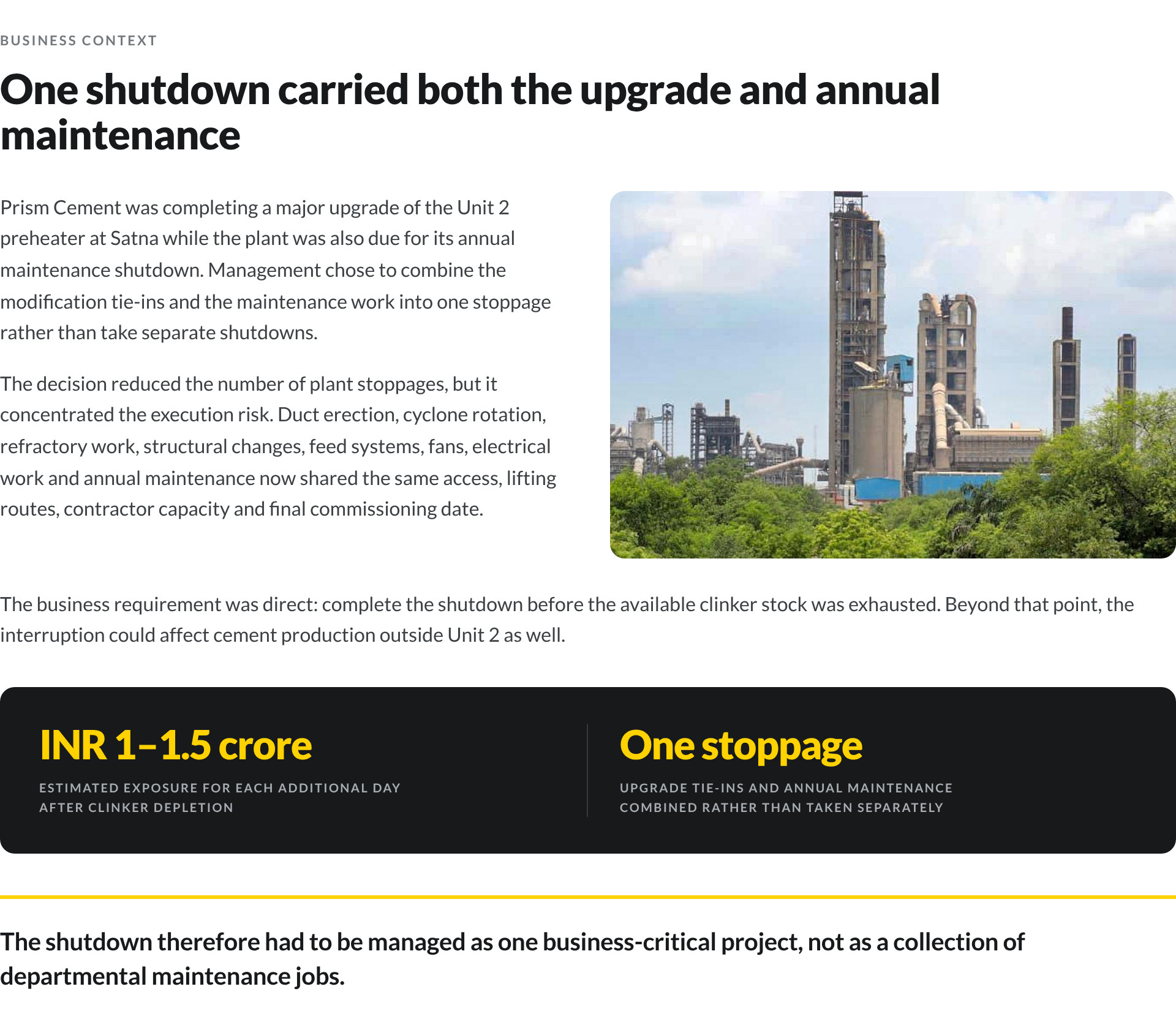
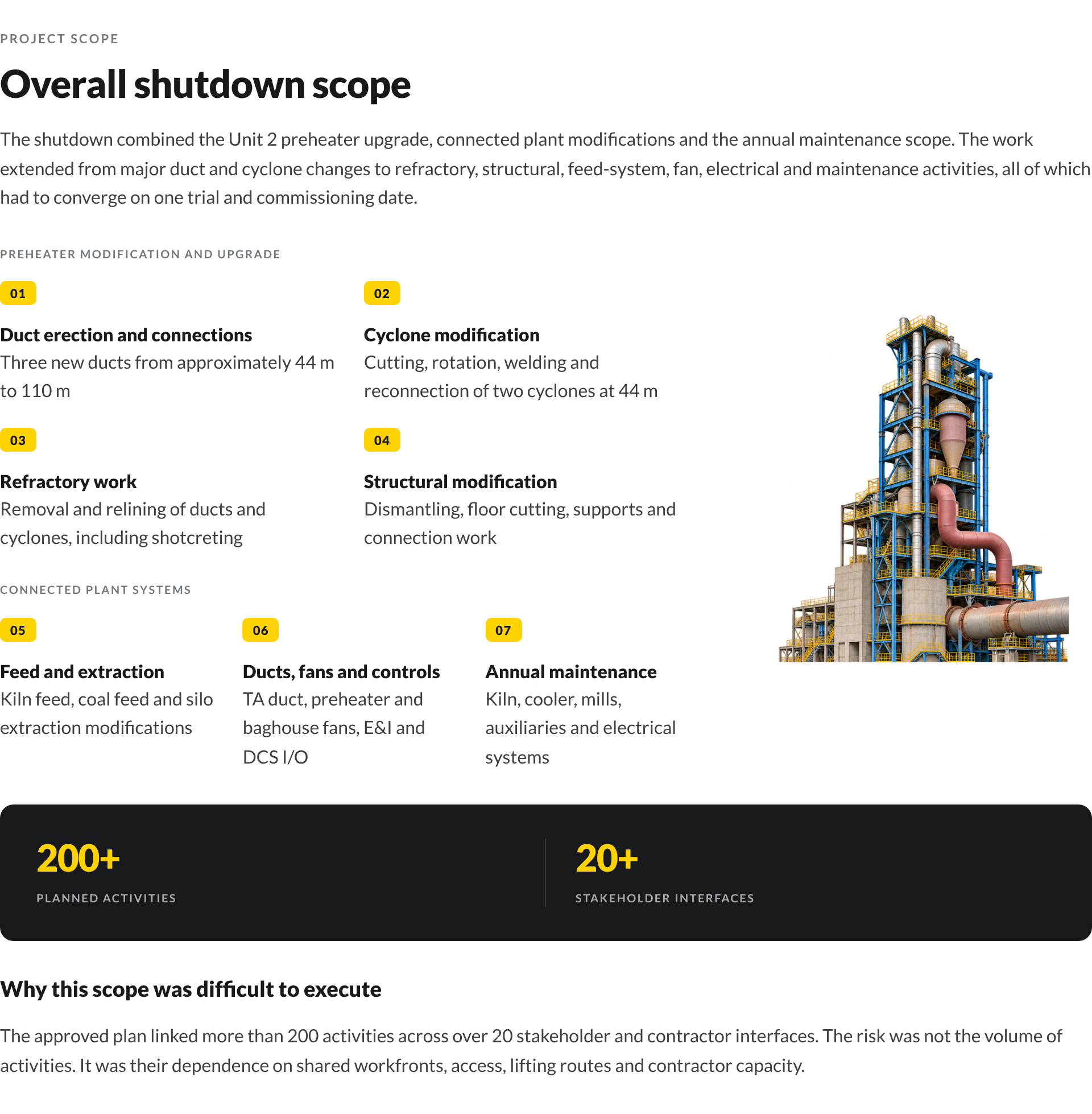
- A major upgrade of the Unit 2 preheater at Satna coincided with the plant’s annual maintenance shutdown, and management combined the modification tie-ins and the maintenance work into one stoppage.
- Fewer plant stoppages, but concentrated execution risk: duct erection, cyclone rotation, refractory work, structural changes, feed systems, fans, electrical work and annual maintenance shared the same access, lifting routes, contractor capacity and final commissioning date.
- The shutdown had to be completed before the available clinker stock was exhausted; beyond that point the interruption could affect cement production outside Unit 2.
- Estimated exposure of approximately INR 1–1.5 crore for each additional day after clinker depletion.
- More than 200 activities across over 20 stakeholder and contractor interfaces, dependent on shared workfronts, access, lifting routes and contractor capacity.
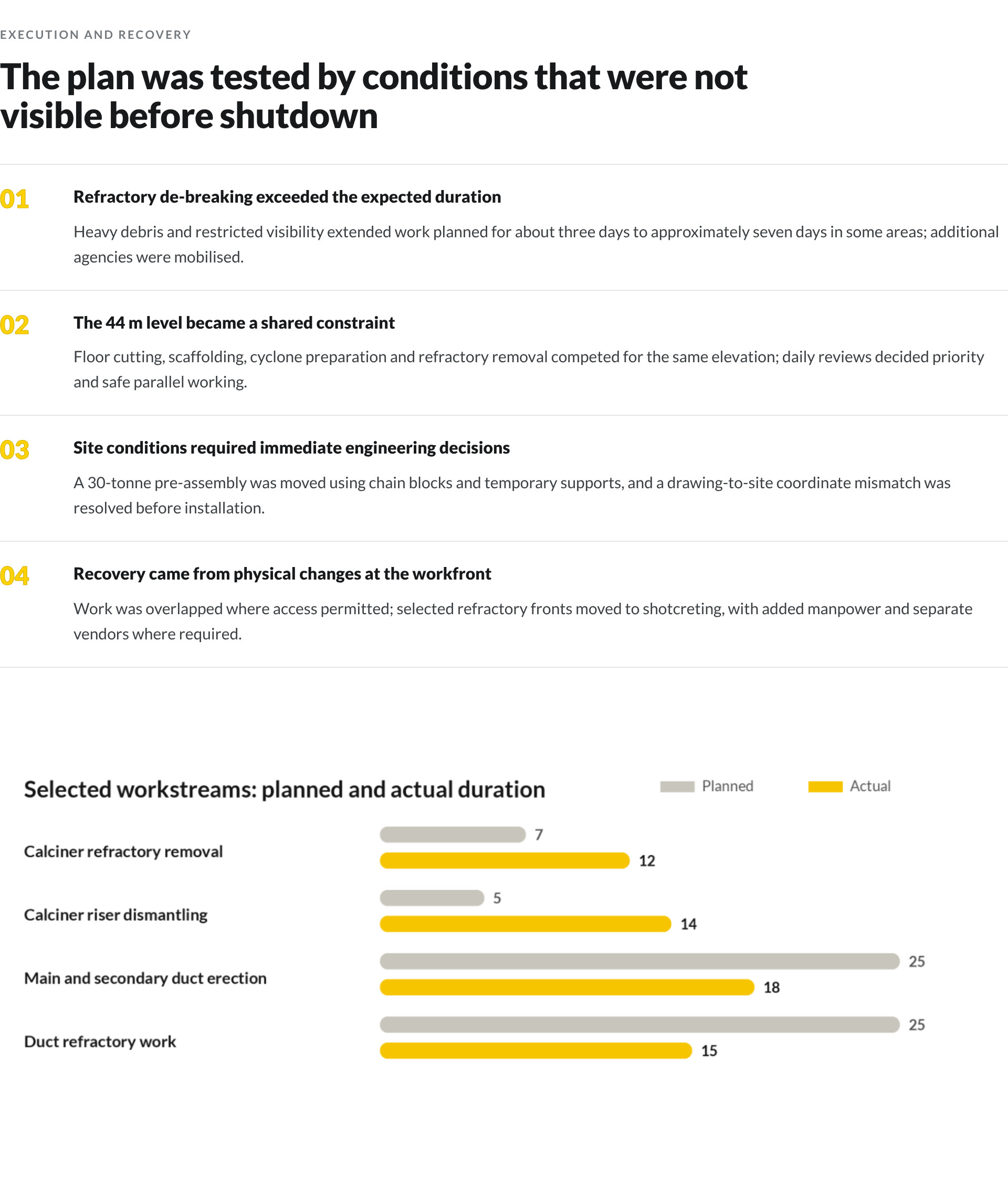
- Floor cutting, scaffolding, cyclone work, duct erection and refractory removal all requiring the same 44 m elevation and access routes.
- 02
Our Work
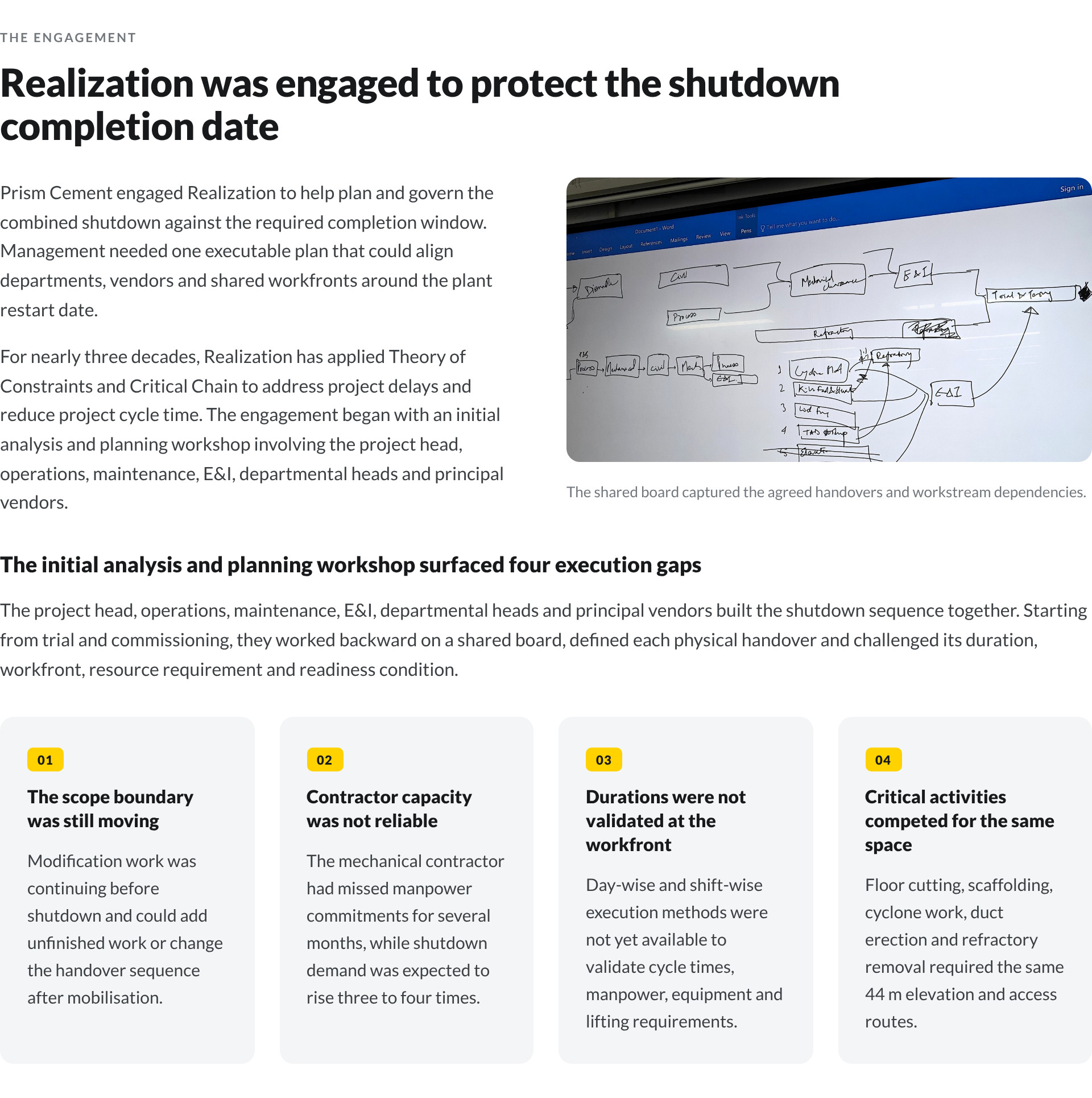
- Ran an initial analysis and planning workshop with the project head, operations, maintenance, E&I, departmental heads and principal vendors.
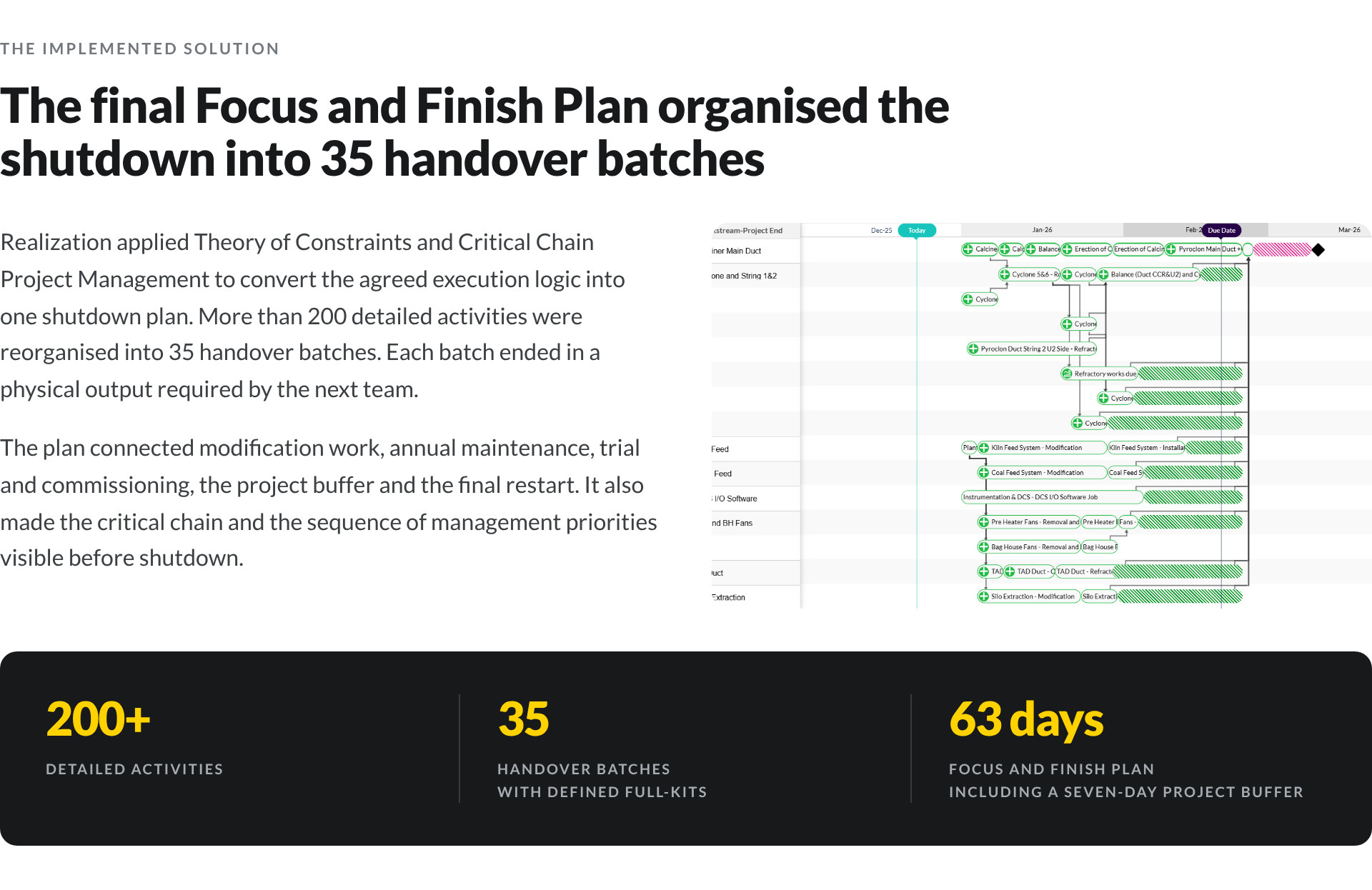
- Built the shutdown sequence backward from trial and commissioning on a shared board, defining each physical handover and challenging its duration, workfront, resource requirement and readiness condition.
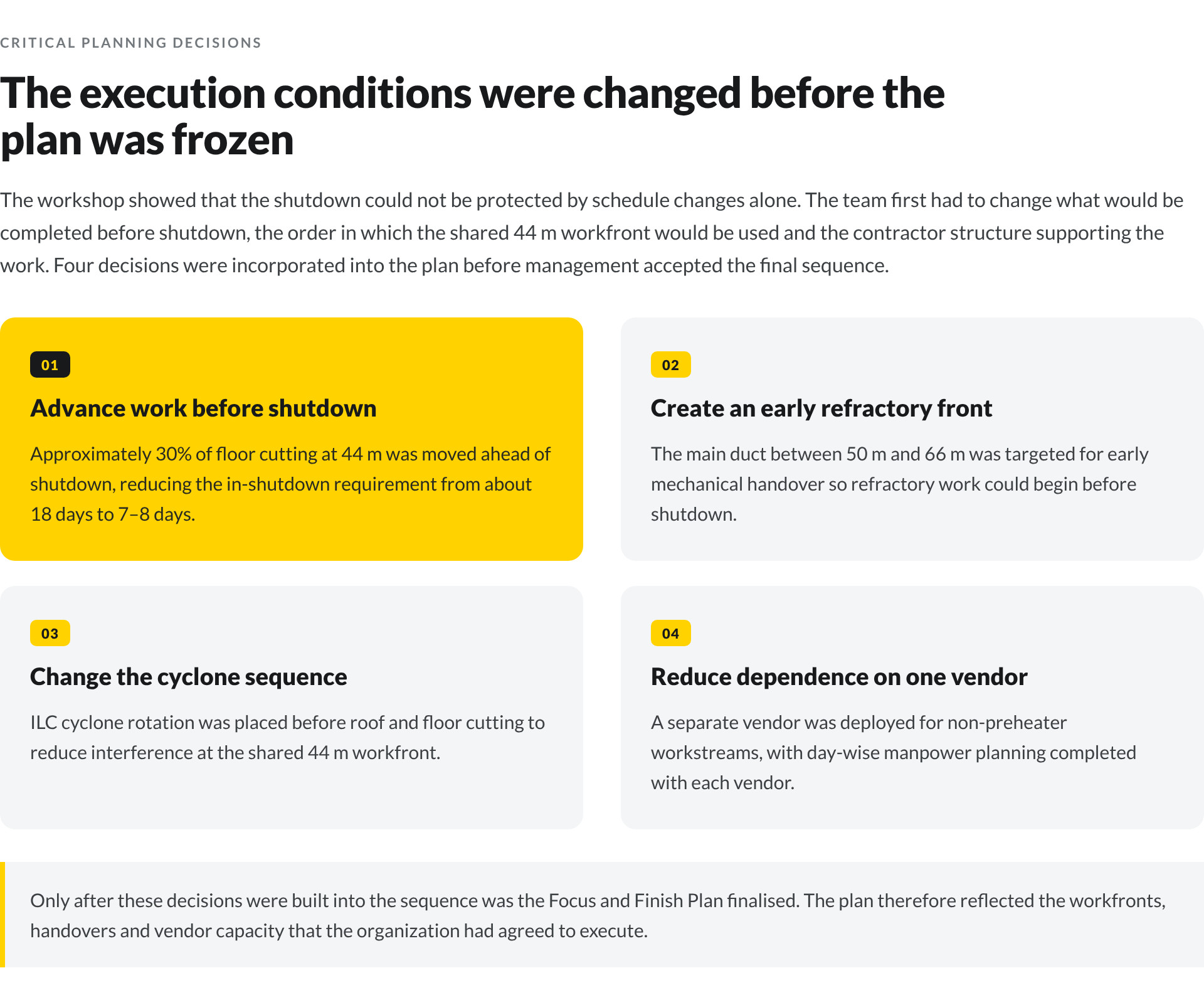
- Moved approximately 30% of floor cutting at 44 m ahead of shutdown, reducing the in-shutdown requirement from about 18 days to 7–8 days.
- Targeted the main duct between 50 m and 66 m for early mechanical handover so refractory work could begin before shutdown.
- Deployed a separate vendor for non-preheater workstreams and completed day-wise manpower planning with each vendor.
- Reorganised more than 200 detailed activities into 35 handover batches, each ending in a physical output required by the next team, within a 63-day Focus and Finish Plan including a seven-day project buffer.
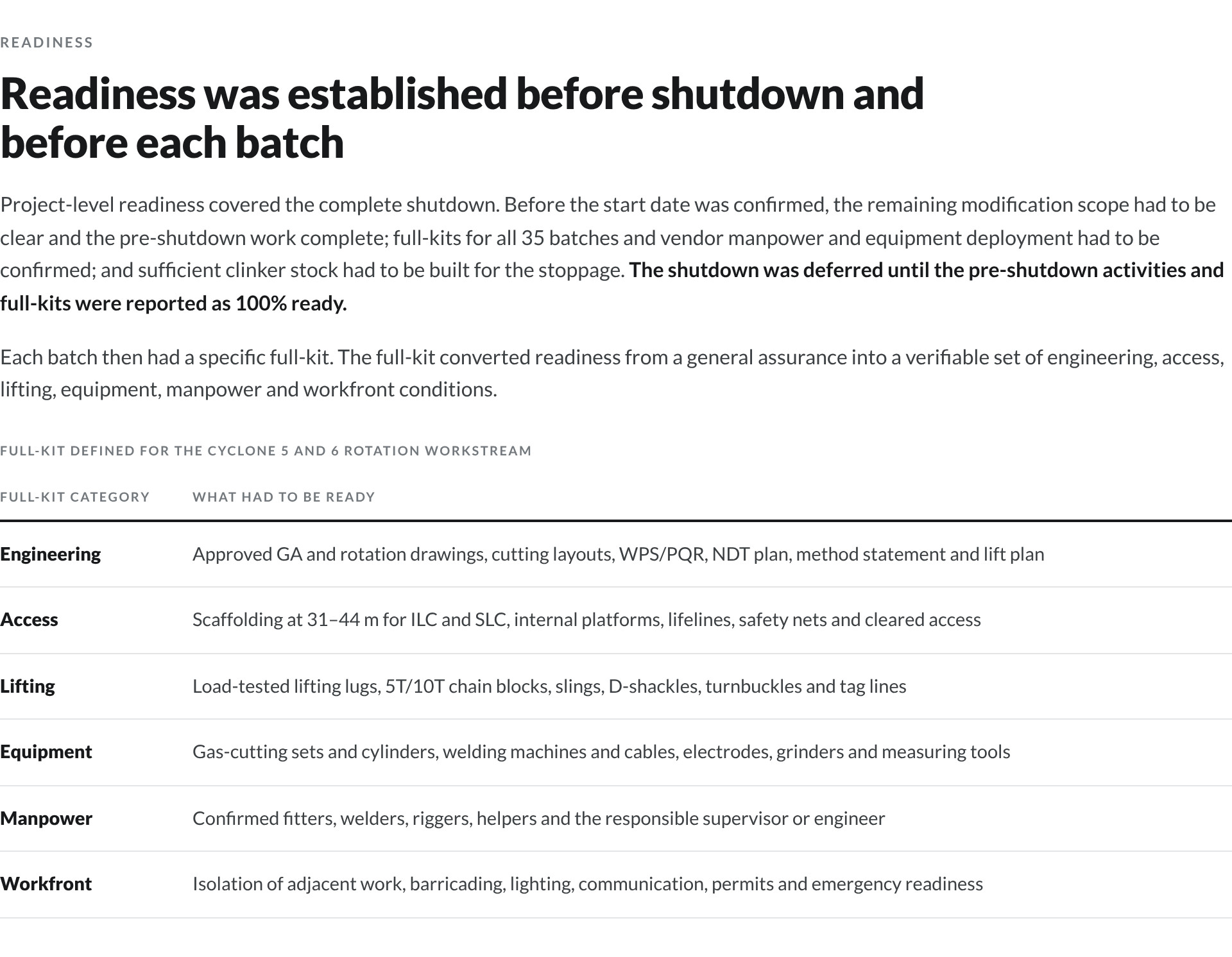
- Defined a full-kit for each batch covering engineering, access, lifting, equipment, manpower and workfront conditions, and deferred the shutdown until pre-shutdown activities and full-kits were reported as 100% ready.
- Broke vendor commitments into day-wise, shift-wise and selected 6-to-12-hour blocks, planning Cyclone 5 rotation as an 11-activity, 11-day sequence with manpower and lifting readiness defined by shift.
- Measured execution through the cycle time of each handover batch, separating a delay in releasing a batch from a delay in executing the work, with daily reviews triggering recovery at the relevant workfront.
- 03
Results
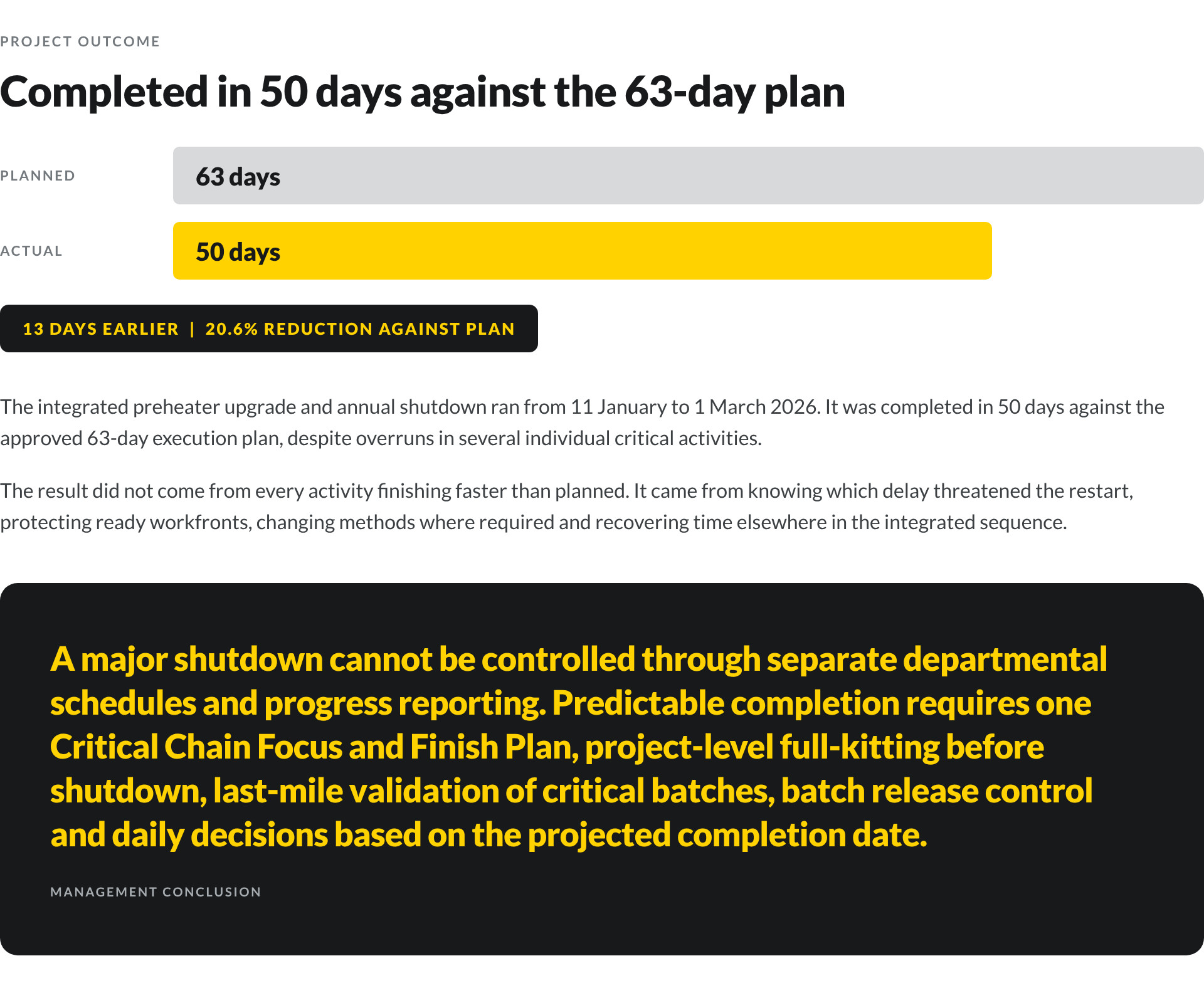
- The integrated preheater upgrade and annual shutdown ran from 11 January to 1 March 2026.
- Completed in 50 days against the approved 63-day execution plan — 13 days earlier, a 20.6% reduction against plan.
- Completion was achieved despite overruns in several individual critical activities.

Read relevant articles:
Critical chain project management (CCPM): why projects remain late and how CCPM actually fixes it?
Why projects are late even when everything seems managed?
Beyond fragmentation: Toyota's cell manufacturing model offers a blueprint for construction
What if our best attempts to minimize time and cost overruns in projects are pointless?
How can we solve the late project problem
Implementing critical chain in large infrastructure projects
Part 1: Why critical chain is not a science


Contact us to find out more
Our Customer Service Teams have hundreds of Industry specific studies to draw from ... get in touch if you want to see something specific to your needs, or simply explore how we can deliver Radical Results for you.

Office No.314, Third Floor, Mont Vert Arcade,
Pashan Sus Road, Pashan Pune. MH- 411021 IN
Pashan Sus Road, Pashan Pune. MH- 411021 IN